
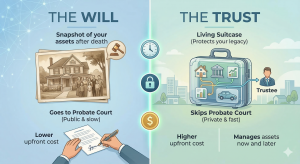
Understanding the difference: A Will acts as a snapshot for the court, while a Trust acts as a “suitcase” that carries your legacy privately.
Estate planning is often one of those “I’ll get to it eventually” tasks. But in 2026, with digital assets, complex family dynamics, and a fast-moving legal landscape, waiting is no longer a safe bet.
When you sit down to protect your legacy, the first question usually is: “Do I need a Will or a Trust?” While both documents dictate who gets your assets, they function very differently. Think of it like a snapshot vs. a living suitcase.
1. The Last Will & Testament: The “Snapshot”
A Will is a legal document that provides instructions on how your assets should be distributed after you pass away.
-
How it works: It remains dormant while you are alive. Upon your death, it “speaks” to the court.
-
The Catch: Wills almost always go through probate. This is a public, court-supervised process that validates the Will. In 2026, probate can take anywhere from six months to two years, and court fees can eat up 3% to 7% of your estate’s value.
-
Unique Power: A Will is the only place where you can legally name guardians for your minor children.
2. The Living Trust: The “Living Suitcase”
A Trust (specifically a Revocable Living Trust) is a legal entity that holds your assets while you’re alive and continues after you’re gone.
-
How it works: You “fund” the trust by retitling your house, bank accounts, and investments into the name of the Trust. You still control everything as the Trustee.
-
The Benefit: Because the Trust owns the assets, there is no need for court intervention. When you pass, your “Successor Trustee” simply follows your instructions. This happens privately and usually within weeks, not years.
-
Incapacity Protection: Unlike a Will, a Trust works while you are alive. If you become ill or incapacitated, your Successor Trustee can step in and manage your finances immediately without a court battle over guardianship.
Side-by-Side Comparison
| Feature | Last Will & Testament | Revocable Living Trust |
| Effective Date | Only after death | Immediately upon signing |
| Probate | Required (Public & Costly) | Bypassed (Private & Fast) |
| Privacy | Public Record | Completely Private |
| Upfront Cost | Lower ($500 – $1,500) | Higher ($2,500 – $4,500) |
| Control | Lump-sum distribution | Can drizzle assets over years |
| Guardianship | Yes (Names guardians) | No |
Which One Is Right For You?
You might prefer a Will if:
-
You have a very simple estate with few assets.
-
Your primary concern is naming guardians for minor children.
-
You want the lowest possible upfront legal cost.
You might prefer a Trust if:
-
You own real estate (especially in multiple states).
-
You want to keep your financial affairs private from nosy neighbors or creditors.
-
You want to protect your heirs from their own “youthful indiscretions” by staggering their inheritance (e.g., 20% at age 25, 30% at age 30, etc.).
The “Pro” Secret: You Usually Need Both
Most modern estate plans use a Living Trust as the primary vehicle and a “Pour-Over Will” as a safety net. The Pour-Over Will catches any assets you forgot to put in the Trust and “pours” them into it after you pass.
Frequently Asked Questions: Wills vs. Trusts
1. Does a Living Trust protect my assets from nursing home costs?
A standard Revocable Living Trust does not typically protect assets from Medicaid spend-down or nursing home costs because you still maintain control over the assets. To protect assets from long-term care costs, you would generally need an Irrevocable Trust. It is best to consult with an elder law attorney to discuss your specific state’s 2026 guidelines.
2. If I have a Trust, do I still need a Will?
Yes. Most estate planners recommend a “Pour-Over Will” to accompany your Trust. This acts as a safety net for any assets you forgot to title in the name of the Trust (like a new bank account or an unexpected inheritance). Without this Will, those “forgotten” assets might still have to go through probate court.
3. Which is more expensive: a Will or a Trust?
A Will is cheaper upfront (usually costing a few hundred dollars), but it can lead to expensive probate fees later. A Trust is more expensive to set up (often ranging from $2,500 to $5,000+), but it usually saves your family thousands of dollars in court costs and legal fees after you pass away by avoiding probate entirely.
Final Pro-Tip for 2026
Since we are in 2026, make sure to mention Digital Assets (like cryptocurrency, social media accounts, and cloud storage) in your FAQ or body text. Search engines are currently prioritizing estate planning content that addresses these modern complexities.
We Can Help ~ Estate Planning in New Baltimore, Chesterfield and Macomb County Michigan
The estate planning attorneys of the Penzien Legal Group, PLLC have been helping families and business owners with their estate planning needs for more than two decades. If you are looking for a compassionate estate planning attorney in New Baltimore that can help you through the estate planning process, conduct a review of your existing estate plan, or if you would like additional information about our services, give us a call at (586) 464-1900, complete our contact us form or book an appointment using our convenient calendar link. Set up a strategy session today.